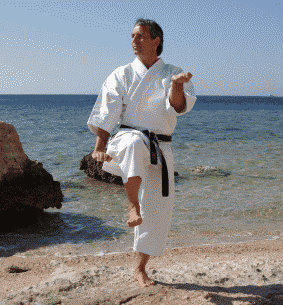
Meaning of the name
Destroy, Disrupt
Moves: 32

Saifa
Classification
Shorei-Ryu
Style
Goju-Ryu / Shito Ryu
Level
Medium
Saifa
is
a
tough
Kata,
and
its
techniques
practice
breaking
the
opponent's
attack
or
destroying
or
breaking
a
grip
or
hold.
The
application
of
the
technique
primarily
requires
willpower
rather
than
physical
strength.
The
techniques
used
are
effective
and
painful
even
with
little
physical
strength.
Additionally,
Saifa
places
high
demands
on
balance
and
the
ability
to
generate
explosive
power.
Lateral
evasive
movements
and
a
technique
in
which
one
literally
goes
around
the
opponent
and
reaches
their
back
are
other
specific
features
of
the
Kata.
Some
techniques
suggest
that
it
originates
from
the
Crane
style.
Furthermore,
in
concept
and
structure,
it
shows
a
strong connection to the Seienchin Kata.

Meaning of the name
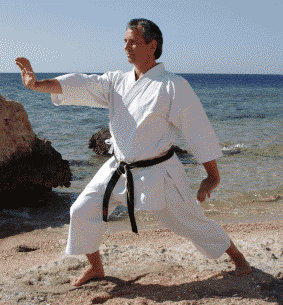
Four fighting monkeys
Moves: 44

Shisochin
Classification
Shorei-Ryu
Style
Goju-Ryu / Shito Ryu
Level
Medium
The
name
Shisochin
is
also
interpreted
as
"Fighting
in
4
Directions."
This
is
meant
philosophically
as
well,
since
the
Kata
also
includes
diagonal
directions,
so
there
are
more
than
just
four.
Shisochin
originates
from
the
Tiger
style
and
is
a
very
powerful
yet
calm
Kata.
It
has
only
two
individual
techniques,
all
other
techniques
are
repeated
up
to
four
times,
suggesting
a
relation
to
Suparimpei
and
Sanseiru.
Shisochin
is
said
to
be
a
very
old
Kata.
Its
training
demands
less
in
terms
of
endurance
and
speed,
and
more
in
the
ability
to
generate
explosive
power.
It
contains
very
direct
attacks,
escape
techniques
against
attacks
from
behind,
and
a
variety
of
arm
locks
up
to
joint
breaking.
Practiced
properly,
it
expresses
self-
confidence and a kind of serene superiority.
This
is
especially
true
for
the
version
practiced
in
Shito-Ryu.
In
particular,
the
middle
section
of
the
Kata
is
performed
and
interpreted
differently
depending
on
the
school
(Goju-Ryu/Shito-Ryu).
It
is
difficult
to
practice
the
Kata
at
the
correct
speed,
as
it
quickly
appears
frantic
and
loses
its
character
if
done
too
fast.
Strangely,
this
also applies in reverse to the slow movements of the Kata.

Meaning of the name
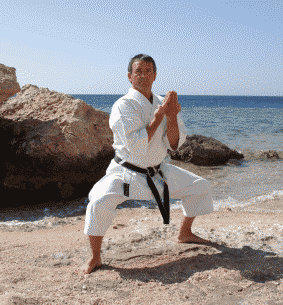
Silence before the storm
Moves: 54
Seienchin
Classification
Shorei-Ryu
Style
Goju-Ryu / Shito Ryu
Level
Medium
Seienchin
is
probably
the
"most
popular"
Kata
of
Naha-te.
It
is
an
extremely
harmonious
Kata,
whose
name
translates
to
'calm
before
the
storm'
and
aptly
describes
the
character
of
the
Kata.
In
the
first
part
of
the
Kata,
where
six
techniques
are
repeated
three
times,
a
unique
sense
of
calm
and
dignity
is
expressed.
Unexpectedly
and
suddenly,
a
true
storm
of
powerful
techniques
with
changing
speed
follows.
For
this
reason,
Seienchin
is
considered
the
typical
Goju-Ryu
Kata.
In
no
other
Kata
are
the
two
aspects,
hard
and
soft,
expressed
so
clearly.
It
is
notable
that
the
Kata
does
not
include
any
foot
techniques.
There
are
differing
opinions,
sometimes
associating
the
Kata
with
the
Crane
style,
sometimes
with
the
Tiger
style.
Considering
the
typical
Katas
of
the
Crane
style
such
as
Nipaipo,
Rohai,
Chinto,
or
even
Hakutsuru,
Seienchin
would
have
to
be
classified
as
an
untypical
Kata
of
this
style
based
solely
on
its
concept.
Perhaps
Seienchin
is
actually
influenced
by
both
styles?
The
concept
or
structure
of
the
Kata
bears
much
similarity
to
that
of
the
Kata Saifa.
Meaning of the name
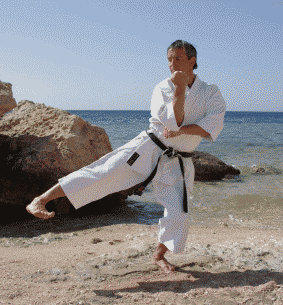
Thirtysix
Moves: 50
Sanseiru
Classification
Shorei-Ryu
Style
Goju-Ryu / Shito Ryu
Level
Medium
The
names
of
the
Kata
Sanseiru,
Seisun,
Seipai,
and
Suparimpei
refer
to
numbers
that
are
said
to
carry
certain
mysticism.
For
example,
the
number
13
(Seisun)
is
considered
a
lucky
number
in
Chinese
culture.
The
case
of
Sanseiru
is
a
bit
more
complicated.
The
basis
for
interpreting
the
name
is
the
result
of
multiplying
6
x
6,
which
equals
36.
The
first
6
is
then
assigned
the
attributes
of
eyes,
ears,
nose,
tongue,
body,
and
mind.
The
second
6
refers
to
color,
voice,
taste,
smell,
touch,
and
justice.
Dividing
36
by
two
yields
18,
which
is
the
significance
of
the
name
Seipai.
Multiplying
36
by
3
gives
108,
and
this is the meaning of Suparimpei.
A
lot
of
meaningful
information
can
be
derived
from
numbers,
and
from
bones
as
well
(according
to
some
fortune
tellers),
but
perhaps
instead
of
pondering
the
mysticism
of
a
Kata's
name
36
times,
one
should
rather
train
it
36
times,
especially
since
it
is
not
certain
that
the
Kata
names
are
still
authentic
today.
Many
Katas
have
been
renamed,
or
the
names
have
been
translated
from
Chinese
into
Okinawan,
which
can
easily
lead
to
misinterpretations.
Much
more
important
and
interesting
is
that
Sanseiru
contains
a
fundamental
concept that resembles the Katas Shisochin and Suparimpei.
These
are
the
only
Okinawan
Kata
in
which
techniques
are
repeated
four
times.
All
other
Kata
include
two,
three,
or
five
repetitions.
And
the
technical
combination
that
is
repeated
four
times
in
Sanseiru
contains
four
techniques.
In
Suparimpei,
four
techniques
are
repeated
twice
and
two
techniques
are
repeated
once,
each
repeated
four
times.
In
Shisochin,
one
technique
is
repeated
four
times.
This
at
least
suggests
that
all
three
Kata
were
developed
with
the
same
conceptual
ideas.
So,
they
probably
originate
from
the
same
Chinese
school.
However,
Sanseiru
is
associated
with
the
Dragon
style
and
Shisochin
with
the
Tiger
style.
Suparimpei
could
be
influenced
by
both
styles.
All
three
Kata
start
with
Sanchin
Dachi
and
Morote
Yoko
Uke
(called
Uchi
Uke
in
Shotokan),
Shisochin
with
Kaishu
(open
hand).
Sanseiru
is
considered
an
advanced
Kata
with
strong
attacking
techniques,
especially
Kansetsu
Geri
targeting
the
knee.
It
contains
many
throwing
techniques
and
diagonal
Evasive
maneuvers
and
a
total of 7 kicks.

Meaning of the name
Thirteen
Moves: 56
Seisun
Classification
Shorei-Ryu
Style
Goju-Ryu / Shito Ryu
Level
Advanced
The
number
13
is
considered
a
lucky
number
in
Chinese
culture.
But
is
it
a
fortunate
circumstance
to
tear
the
opponent's
larynx,
as
Seisun
(old
version)
teaches?
Seisun
is
probably
the
oldest
Kata
of
Naha-te.
In
Shuri-te,
a
Seishan
(Sesan)
is
known,
which
is
considered
the
Shuri-te
version
of
Seisun,
but
is
actually
an
independent
Kata
that
also served as the basis for Shotokan's Hangetsu.
Seisun
is
a
high-level
Kata.
From
the
outside,
it
sometimes
appears
light
and
lacking
in
expression.
However,
anyone
who
trains
the
Kata
seriously
comes
to
appreciate
its
unique
inner
dynamics.
It
also
begins
with
Morote
Yoko
Uke
in
Sanchin
Dachi
but
then
follows
a
structure
different
from
Sanseiru,
Shisochin,
and
Suparimpei.
Various
techniques
from
Seisun
also
appear
in
Seienchin,
Suparimpei,
and
Sanchin.
Kansetsu
Geri
is
also
performed,
as
in
Sanseiru.
One
could
speculate
a
lot
about
whether
Seisun
is
actually
an
older
Chinese
Kata
or
a
more
recent
Okinawan
development.
In
any
case,
the
creator of the Kata, as in many cases, remains unknown.
However,
this
does
not
change
the
value
of
the
Kata.
And
based
on
the
techniques
used,
I
suspect
it
belongs
to
the
Tiger
style.
In
some
schools, however, the attack to the throat is hidden or obscured.
Meaning of the name
Eightteen
Moves: 47
Seipai
Classification
Shorei-Ryu
Style
Goju-Ryu / Shito Ryu
Level
Advanced
Just
as
the
number
36
is
considered
mystical
in
Sanseiru,
the
number
18
is
also
regarded
and
described
mystically.
In
this
case,
3
x
6
=
18,
and
as
in
Sanseiru,
the
6
is
again
associated
with
the
attributes
eyes,
ears,
nose,
tongue,
body,
and
mind,
while
the
three
stand
for
good,
evil,
and
peace.
This
interpretation,
as
in
Sanseiru,
Seisun,
and
Suparimpei,
is
not
without
doubt
and
is
probably
of
more
recent
origin.
The
character
and
content
of
the
Kata
are
not
accurately
described by these interpretations of the names.
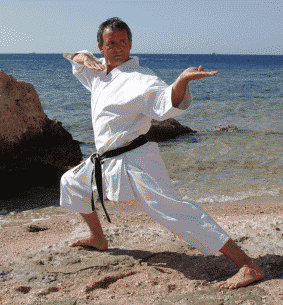
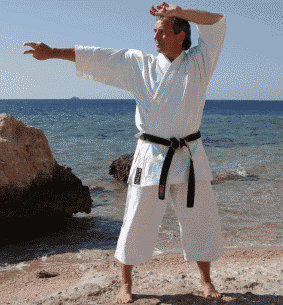
Seipai
is
an
extraordinary
Kata
with
very
strong
self-defense
techniques,
especially
against
grabs.
Seipai
is
very
versatile.
No
technique
is
repeated
more
than
twice.
It
begins
with
a
very
difficult
combination
of
techniques
which,
when
performed
correctly,
express
a
high
degree
of
dignity,
strength,
and
assertiveness.
The
transition
between
calm
and
dynamic
techniques
is
striking.
The
calm,
smoothly
soft
technique
is
followed,
like
an
explosion,
by
the
fast,
dynamic
technique.
The
Kata
teaches
a
"wild,"
determined
fighting
style
for
close-range
combat
and
includes
many
throwing
and
joint-lock
techniques.
Footwork
in
the
form
of
tai-sabaki
and
turns
places
the
highest
demands
on
coordination
and
balance.
Seipai
is
associated
with
the
crane
style
and
is
overall
of
a
high
level.
The
concept,
structure,
and
some
techniques
are
reminiscent
of
the
Kata
Kururunfa.
Meaning of the name
Hold and Destroy
Moves: 52
Kururunfa
Classification
Shorei-Ryu
Style
Goju-Ryu / Shito Ryu
Level
Advanced
The
Kata
is
in
many
parts
similar
to
the
Kata
Niseishi,
a
Kata
which
was
done
in
the
Aragaki
school
of
Niigaki
(a
village
between
Tomari
and Naha).
Kururunfa
is
the
only
original
Kata
of
Goju-Ryu
which
don't
start
to
the
front
but
to
the
left
side.
In
former
times
it
did
start
with
Kote
Uke
and
Otoshi
Empi
and
more
Hiraken
was
used.
This
allows
to
suppose
that
the
Kata
comes
from
the
chinese
style
of
Leopard.
Some
the
techniques
will
be
done
flashlight,
similar
to
the
praw
of
a
cat.
In
the
rhythm
of
changes
of
speed
(from
slow
to
fast)
we
see
a
advanced skills and explosivity.
The
relationship
to
the
Nijushiho
(Nisesihi)
is
not
only
by
the
concept
and
Enbusen
of
the
Kata,
but
also
to
see
in
the
include
techniques
especially the combinations.
And
this
is
even
more
to
see
in
Nijushiho
than
in
the
original
version
Niseishi.
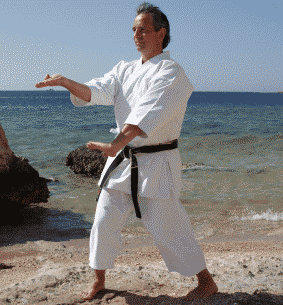
Kururunfa
is
known
as
the
bone
brake
Kata.
A
lot
of
it’s
techniques,
including
the
throwing
techniques,
are
for
to
brake
bones
or joints.
It's
not
good
to
have
a
wrong
impression
in
view
of
some
slowly
and
mooth movements. The Bunkai will show the painful true.
Meaning of the name
Onehundredeight
Moves: 108
Suparimpei
Classification
Shorei-Ryu
Style
Goju-Ryu / Shito Ryu
Level
Advanced
It‘s
Chinese
name
is
Peichurin.
Suparimpei
is
the
longest
Kata
of
Naha-te.
Four
difficult
technical
combinations
are
each
repeated
four
times.
Furthermore,
it
contains
a
variety
of
combinations
with
turns
of
up
to
360
degrees
and
a
very
difficult
Nidan-Geri
to
execute.
The
peculiarity
of
the
quadruple
repetition,
which
it
shares
with
Sanseiru
and
Shisochin,
suggests
that
these
three
Katas
originate
from
the
same
Chinese
school.
In
this
case
as
well,
a
significance
for
the
number
108
has
been
sought.
Sometimes
it
is
said
that
108
masters
were
involved
in
the
development
of
Suparimpei.
Or
it
is
believed
that
it
contains
108
different
techniques,
up
to
the
108
evil
traits
of
humans.
Depending
on
the
version
of
the
Kata,
there
are
also
a
total
of
108
movements.
And
only
a
few
Katas,
such
as
the
old
form
of
Hakutsuru,
have
even
more
movements.
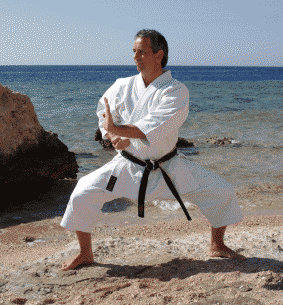
Suparimpei
contains
very
different
techniques.
Some
are
very
complex
in
their
application,
others
require
a
strong
will
for
uncompromising
attack.
On
the
surface,
it
is
not
difficult
to
learn
the
sequence
of
the
Kata.
However,
it
is
extremely
difficult
to
execute
the
techniques
correctly.
Some
require
a
special
softness
and
flexibility
of
the
hips,
with
synchronous
yet
powerful
arm
movements,
along
with
a
special
breathing
technique.
In
contrast
to
fast,
acrobatic
Katas
like
Unsu,
the
difficulty
of
Suparimpei
lies
in
the
details
and
remains
hidden
to
the
untrained
eye.
The
older
versions
of
the
Kata
are
even
considerably
more
difficult than today's (straightened) versions.

Meaning of the name
Three phases
Moves: 48

Sanchin
Classification
Shorei-Ryu
Style
Goju-Ryu / Shito Ryu
Level
Advanced
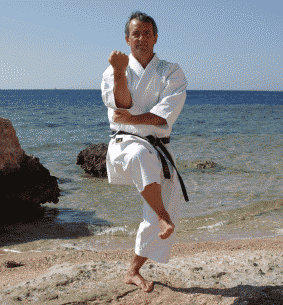
Sanchin
is
considered
the
most
important
Kata
of
Naha-te.
In
Sanchin,
it
is
less
about
the
combat
principles
and
more
about
the
potential
of
the
Kata
for
the
physical
development
of
the
practitioner.
Daily
training
of
Sanchin
strengthens
the
muscles
and,
in
particular,
the
ability
for
isometric
tension,
from
individual
muscles
and
muscle
groups
to
the
complete
contraction
of
all
muscles,
which
is
very
difficult
and
requires
a
high
level
of
concentration.
Furthermore,
Sanchin
enhances
breathing,
teaching
not
only
a
special
form
of
exhalation
using
the
muscles
in
the
diaphragm
area
but
also
the
ability
to
control
and
increase
muscle
tension
through
breathing
to
compensate
for
the
impact
of
blows.
With
perfect
mastery
of
this
technique, this happens automatically at the moment of impact.
The
rule
applies
that
anyone
who
can
perform
Sanchin
more
than
twice
in
a
row
does
not
do
so
with
the
full
effort
required
for
the
Kata.
But
it
is
precisely
this
effort
that
is
necessary
to
train
successfully
with
Sanchin.
In
earlier
times
and
in
some
schools
like
Uechi-Ryu,
the
Kata
is
still
used
today
for
hardening.
For
this
purpose,
during
the
execution
of
the
Kata,
strikes
are
made
with
a
stick
or
fists
to
the
abdomen,
back,
arms,
and
legs.
Sanchin
is
neither
a
versatile,
elegant,
nor
aesthetically
pleasing
Kata.
It
is
a
uncompromising
power
Kata,
and
despite
its
apparent
simplicity,
it
takes
years
to
master it.
Historically,
a
kinship
with
Happoren
is
suspected.
However,
Happoren
also
includes
soft
principles
and
differs
greatly
from
Sanchin.
At
best,
one
could
assume
that
Sanchin
represents
a
kind
of
preliminary
exercise
for
Happoren.
This
is
not
proven,
and
one
could
also
believe
that
Sanchin
simply
exists
to
be
Sanchin
and
to
strengthen
the
body.
The
original
version
is
trained
with
open
hands
and
also
includes
fast
movements with an associated very difficult breathing technique.
Chojun
Miyagi
changed
these
to
the
version
practiced
today
with
a
closed
fist.
In
this
case,
it
was
probably
less
about
the
reduced
danger
of
techniques
with
a
closed
fist
than
rather
about
the
fact
that
the
muscle
tension
can
be
practiced
much
more
easily
using
the
closed
fist.
However,
the
Ibuki
breathing
used
by
Miyagi
is
suspected
to
be
bad
for
health.
While
breathing
techniques
can
indeed
affect
heart
activity,
the
extent
to
which
this
breathing
technique
promotes
heart disease (as is suspected) has neither been studied nor proven.

Meaning of the name
Turning palms
Moves: 44

Tensho
Classification
Shorei-Ryu
Style
Goju-Ryu / Shito Ryu
Level
Advanced
This
Kata
was
developed
by
Chojun
Miyagi,
the
founder
of
Goju-Ryu.
Probably
based
on
the
Kata
Rokkishu,
which,
however,
is
not
officially
taught
in
any
known
school.
The
nature
of
the
technique
suggests
a
relation
to
the
Praying
Mantis
school.
Some
assume
that
Sanchin
represents
the
hard
part
and
Tensho
the
soft
part
of
Happoren.
Other
theories
refer
to
the
Kata
Hakufa
as
the
basis
for
Tensho.
However,
the
better-known
theory
is
that
Chojun
Miyagi
developed
the
Kata
after
studying
and
modeling
it
on
the
Kata
Rokkishu
as
a
clear
practice
form
of
Ju,
the
soft
part
of
his
Goju-Ryu,
which
he
created
based on the karate of Kanryo Higashionna (Shorei-Ryu, Naha).
And
indeed,
it
is
very
difficult
to
practice
the
Kata
Tensho
with
its
own
and
necessary
softness.
It
is
all
too
easy
to
fall
into
the
concept
of
kime
and
tension.
The
idea
that
one
can
achieve
effect
with
a
soft,
loose,
relaxed
movement
seems
too
far-fetched.
In
any
case,
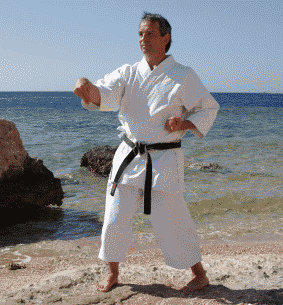
Tensho
is
the
absolute
opposite
of
Sanchin,
although
the
last
four
techniques
of
both
Katas
are
almost
identical.
But
precisely
this
makes
it
difficult
to
practice
Tensho
to
the
end
in
the
Ju
range.
Unlike
Sanchin,
the
technical
application
of
Tensho
is
extremely
versatile.
Defense
and
counterattack
can
be
executed
at
any
level
and
at
any
time.
Both
the
blocking
and
attacking
techniques
are
very
short
and
yet
very
painful.
Tensho,
like
Sanchin,
is
practiced
exclusively
in
Sanchin
Dachi,
with
three
steps
forward
and
four
steps
back.
A
turn
as
in
Sanchin
does
not exist.
Very
few
can
resist
the
elegance
of
this
Kata.
It
is
often
practiced
at
the
beginning
(as
a
warm-up
exercise)
and
towards
the
end
of
a
training
session.
And
perhaps
it
is
precisely
practicing
it
at
the
end
of
a
tough
workout,
when
you
have
no
energy
left
and
it
is
really
hard
to
make
an
effort,
that
is
the
right
moment
for
this
Kata,
which
does
without
strength,
fast
movements,
hardness,
and
kime.
Moreover,
it
is
probably
the
only
Kata
in
which
no
kiai
is
intended.
Whether
Tensho
was
primarily
influenced
by
Happoren,
Hakufa,
or
Rokkishu
is
of
less
importance;
ultimately,
only
Chojun
Miyagi
himself
could
provide the answer as to which ideas led him to develop Tensho.
Datenschutzerklärung:
Bei
karatekata.de
handelt
es
sich
um
ein
rein
informatives
Online
Angebot ohne kommerzielle Funktionen.
Alle
hier
veröffentlichten
Publikationen
enthalten
persönliche
Meinungen
des
Autors.
In
Fällen,
in
denen
externe
Informationen
eingebunden
werden,
werden
entsprechende
Quellenangaben
hinzugefügt.
Links
zu
anderen
Internetangeboten
oder
automatische
Weiterleitungen
sind
nicht
implementiert.
Navigation
Kata

DSGVO relevante Cookies sind nicht implementiert.
































































karatekata.de



