Meaning of the name
Light from the South
Moves: 56

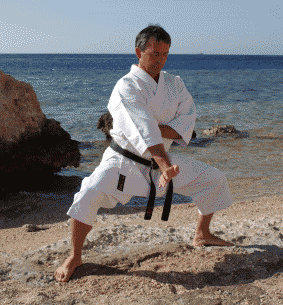
Ananko
Classification
Shorin-Ryu
Style
Shito Ryu
Level
Medium
The
Ananko
Kata
was
introduced
to
Shuri-te
by
Chotoku
Kyan.
It
is
said
that
he
learned
the
Kata
in
Taiwan
and
brought
it
to
Okinawa.
Thus,
at
least
on
Okinawa,
it
is
not
an
ancient
Kata
like
Kushanku
or
Patsai.
At
least
two
versions
exist,
one
of
them
considerably
longer
and
more
versatile.
Some
passages
are
reminiscent
of
Gojushiho.
Ananko
is
practiced
in
various
schools
of
Shorin-ryu
and
Shito-ryu.
There
are
speculations
about
the
origin
of
this
Kata.
One
is
said
to
have
been
developed
by
Kyan
himself.
Another
is
attributed
to
the
Chinese
martial
arts
expert
Anan,
to
whom
the
Ryuei-ryu
Kata
Anan
is
also
attributed.
This
is
extremely
unlikely,
however,
since
Anan
and
Annako
are
not
only
different
Kata,
but
the
principles,
concepts,
and
techniques
used
also
differ.
Furthermore,
the
name
of
the
Kata
Anan
actually
refers
to
a
city
in
China.
More
interesting,
however,
is
that
the
longer
version
of
Ananko
includes
a
grappling
technique
that
is
identical
to
a
Seipai
technique.
Another
technique
in
which
Soto
Uke
is
struck
into
the
open
hand
can
be
found
in
the
Kata
Empi.
Furthermore,
Ananko
contains
very
beautiful
combinations
that
are
applied with a lot of pressure.

Meaning of the name
Breackthrough the Fortress
Moves: 51
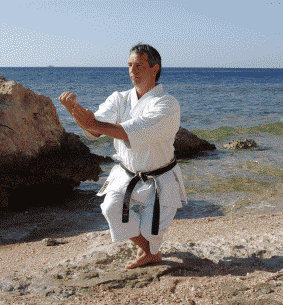
Bassai Dai
Classification
Shorin-Ryu
Style
Shito Ryu / Shotokan
Level
Medium
Bassai
Dai
is
a
work
by
Yasutsune
Itosu.
He
developed
it
based
on
the
Patsai
of
Tomari-te
(Tomari
Bassai).
Only
the
beginning
of
the
Kata
with
the
combination
Yoko
Uke
/
Gyaku
Yoko
Uke
(note:
in
Shotokan,
Yoko
Uke
is
called
Uchi
Uke
and
Gyaku
Yoko
Uke
is
called
Soto
Uke)
distinguishes
Bassai
Dai
from
the
original
form.
All
other
techniques
have
been
slightly
modified.
This
Bassai
Dai
is
a
Kata
that
also
contains
some
soft
and
slow
elements.
It
is
therefore
highly
dynamic
and
harmonious
and,
especially
at
the
end,
very
elegant.
In
Shotokan, however, the soft elements were removed.
In
Shito-ryu,
the
Kata
represents
Shuri-te
and,
along
with
Seienchin,
is
mandatory
for
the
master
level
of
Shodan.
Bassai
Dai
is
one
of
the
most
widely
practiced
Kata
in
Okinawa.
It
is
practiced
in
many
schools
but
is
also
subject
to
many
changes.
Bassai
Dai
teaches
a
fighting
style
characterized
by
very
sudden,
penetrating
actions.
Short
moments
of
calm
are
followed
by
extremely
explosive
techniques.
Many
of
these
aim
to
break
and
destroy
bones
and
joints.
The
nature
of
the
Kata
is
offensive,
and
even
the
throwing
techniques
it contains have a joint-destructive effect.
The
meaning
of
the
name
“breaking
through
the
fortress”
can
be
understood
as
meaning
that
each
technique
is
performed
in
a
way
that is suitable to overcome any “obstacle”.

Meaning of the name
Breackthrough the Fortress
Moves: 34
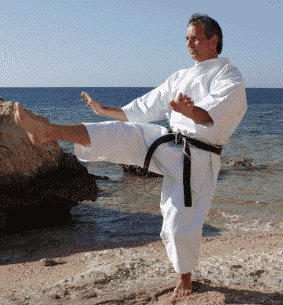
Bassai Sho
Classification
Shorin-Ryu
Style
Shito Ryu / Shotokan
Level
Medium
Bassai
Sho
is
also
a
work
by
Yasutsune
Itosu,
but
it
doesn't
nearly
achieve
the
prominence
of
Bassai
Dai.
The
smaller
version
of
Bassai
(sho
means
small)
is
shorter
and
contains
techniques
for
fighting
in
close
proximity
to
the
opponent.
Many
techniques
target
the
joints
of
the
arms
and
legs.
It
also
contains
some
very
dynamic
throwing
techniques.
Although
it
is
certainly
a
high-level
Kata,
it
is
rarely
practiced.
Neither
in
Shotokan
nor
in
Shito-ryu
has
it
achieved
the
same level of importance as its big sister, Bassai Dai.

Meaning of the name
Breackthrough the Fortress
Moves: 58

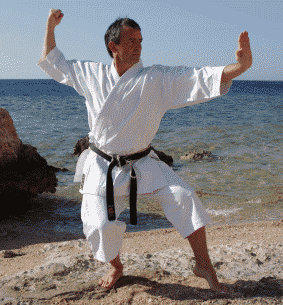
Matsumura Bassai
Classification
Shorin-Ryu
Style
Shito Ryu
Level
Advanced
Matsumura
Bassai
is
considered
the
most
highly
developed
form
of
Patsai/Bassai
in
Okinawa.
Sokon
Matsumura
was
one
of
the
most
important
masters
of
Shuri-te
and
a
teacher
of
Anko
Azato,
the
teacher
of
Gichin
Funakoshi.
Yasutsune
Itosu
was
also
a
student
of
Matsumura.
Sokon
Matsumura
was
also
an
instructor
of
the
bodyguard of the kings of Okinawa.
It
is
said
that
he
developed
the
two
Heian
Kata
(Shodan
and
Nidan)
and
possibly
also
the
first
two
Naifanchin
(Shodan
and
Nidan).
He
was
also
a
master
of
Kobudo
and
developed
the
Matsumura
no
Kon,
a
Kata for the staff (Bo).
However,
his
most
famous
version
of
Patsai
is
very
demanding,
and
some
techniques
require
truly
perfect
execution
to
achieve
their
full
effect. When used correctly, these techniques are extremely effective.
The
Kata
also
contains
very
fast
combinations
and
very
dynamic
techniques.
Some
grappling
and
lever
techniques
possess
very
high
pulling
power,
as
the
entire
body
weight
is
used.
And
this
is
a
key
characteristic
of
the
Kata,
as
the
effect
of
the
technique
is
created
by
the
way
it
is
executed
and
the
use
of
body
weight.
Muscle
strength
is
less
important,
which
is
why
the
Kata
sometimes
appears
somewhat
powerless.
This
is
a
superficial
impression,
but
one
whose
inaccuracy
is quickly recognized in the bunkai.

Meaning of the name
Breackthrough the Fortress
Moves: 55

Tomari Bassai
Classification
Shorin-Ryu
Style
Shito Ryu
Level
Advanced
It
is
believed
that
this
Kata
came
to
Okinawa
before
Kushanku.
Its
original
name
is
Patsai.
It
is
definitely
a
very
old
Kata.
In
fact,
some
of
Patsai's
techniques
suggest
a
relationship
to
Kushanku.
Unfortunately,
it
is
not
certain
whether
these
techniques
were
not
added
later.
Similar
to
Kushanku
and,
to
a
lesser
extent,
Rohai,
Patsai
has
been
adopted
by
many
masters
and
has
often
been
modified.
The
Patsai
form
of
Matsubayashi
Shorin
Ryu
by
Chotoku
Kyan
comes
from
the
Tomari
line
and
is
also
known
as
Tomari
Bassai
or
Oyadomari
Bassai.
It
is
considered
the
oldest
version
and,
like
all
Tomari
Kata,
the
version
that
deviates
least
from
the
Chinese
original.
The
first
part
of
the
Kata
uses
many
open
hand
techniques
that
are
executed
at
very
high
speed.
Overall,
the
Kata
is
more
dynamic
than
the
later
versions
Bassai
Dai
and
Sho.
The
meaning
of
the
name,
with
storming
the
fortress
or
breaking
through
the
fortress,
describes
the
character
of
the
Kata.
The
techniques
should
be
performed
in
a
way
that tolerates no contradiction and breaks down every obstacle.

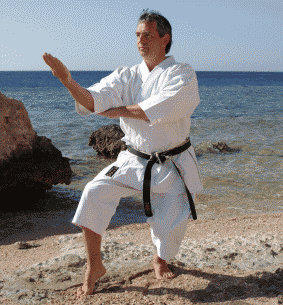
Meaning of the name
Seldom hand
Moves: 38

Chinte
Classification
Shorin-Ryu
Style
Shito Ryu / Shotokan
Level
Medium
If
one
can
even
speak
of
"good"
and
"bad"
Kata,
then
Chinte
is
an
"bad"
Kata.
Almost
all
techniques
are
intended
to
inflict
serious,
sometimes
irreparable
injuries
on
the
opponent.
Anyone
who
trains
Chinte
with
knowledge
of
the
bunkai
also
learns
the
idea
of
uncompromising
destruction
of
the
opponent.
However,
this
is
not
openly
apparent
when
the
Kata
is
executed.
Here
it
sometimes
even
seems
harmless.
The
three
jumps
that
are
performed
at
the
end
in
the
Shotokan
version
can
be
interpreted
as
a
bunkai,
but
here
the
idea
of
returning
the
Kata
to
its
starting
point
could
also
have
been
the
main
reason.
None
of
the
old
Kata
was
"constructed"
in
such
a
way
that
it
always
returns
to
the
starting
point.
Only
in
Shotokan
does
the
basic
rule
apply
that
a
Kata
ends
at
the
same
point
where
it
starts.
However,
the
three
jumps,
if
performed
correctly,
also
teach
a
special form of Yori Ashi.

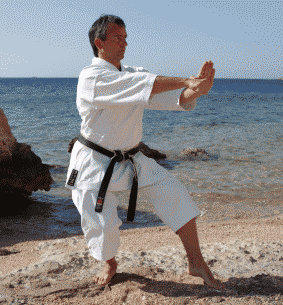
Meaning of the name
Fighting to the East
Moves: 52

Chinto
Classification
Shorin-Ryu
Style
Shito Ryu / Shotokan
Level
Advanced
Old
stories
tell
of
Sokon
Matsumura
meeting
a
Chinese
sailor
who
was
shipwrecked
off
Okinawa.
It
is
said
that
Matsumura
was
commissioned
by
the
king
to
investigate
rumors
about
this
Chinese
sailor,
search
for
him,
and
capture
him.
A
fight
is
even
said
to
have
broken
out,
but
in
this
case,
it
likely
ended
in
a
friendship.
Finally,
it
is
certain
that
Matsumura
learned
the
Kata
Chinto
from
this
very
Chinese sailor.
Because
of
the
big
differences
between
Chinto
and
Tomari
Chinto,
the
question
arises
as
to
whether
Matsumura
really
only
learned
one
Kata.
There
is
also
supposed
to
be
a
third
variant.
According
to
Hirokazu
Kanazawa,
there
are
three
versions.
All
three
are
characterized
by
the
straight
Enbusen,
although
each
version
has
its
own
direction.
In
Chinto
(Gankaku)
it
goes
straight
forward,
in
Tomari
Chinto
it
is
45
degrees
diagonally,
and
the
third
version
is
supposed
to
go
sideways.
The
Kata
Chinto
very
specifically
trains
the
sense
of
balance.
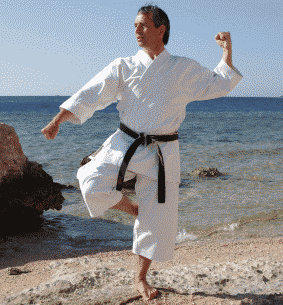
This
includes
techniques
that
are
performed
standing
on
one
leg,
but
also
difficult
turns.
A
special
feature
of
the
Kata
is
Zanshin.
The
concentration
of
attention
on
the
opponent
is
practiced
here
in
a
form
that
involves
a
purely
mental
overcoming
of
the
opponent.
Either
to
prevent
an
attack,
or
with
the
aim
of
weakening
their
concentration in order to then launch a surprise attack.

Meaning of the name
Fighting to the East
Moves: 55

Tomari Chint0
Classification
Shorin-Ryu
Style
Shito Ryu
Level
Advanced
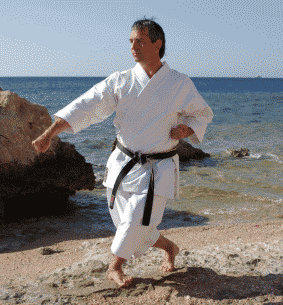
This
version
of
Chinto,
whose
enbusen
runs
diagonally
and
bears
little
resemblance
to
the
Chinto
of
the
Itsou
school,
was
adopted
by
Chotoku Kyu in his Shorin Ryu school.
The
Tomari
Chinto
appears
more
"Chinese,"
so
it
could
be
an
unaltered version.
The
similarity
to
the
White
Crane
style
is
also
clearly
evident
here.
Tomari
Chinto
is
an
extremely
dynamic
Kata.
Its
technical
combinations
are
very
harmonious
and
appropriate
to
the
body.
The
combative
implementation
of
the
Kata
is
very
effective,
and
many
techniques are capable of causing permanent damage.

Meaning of the name
Music of the temple
Moves: 51
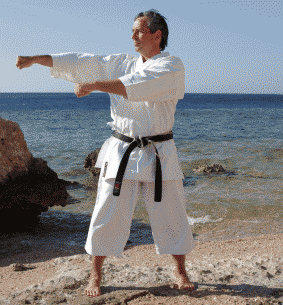
Jion
Classification
Shorin-Ryu
Style
Shito Ryu / Shotokan
Level
Medium
The
Kata
Jion,
Ji’in
and
Jitte
show
a
very
clear
relationship.
In
any
case,
they
appear
to
come
from
the
same
school.
Some
suspect
that
Ji’in
and
Jitte
are
simply
versions
of
the
Kata
Jion.
In
fact,
one
could
assume
that
Itosu
developed
the
versions
Ji’in
and
Jitte
based
on
the
Kata
Jion.
This
contradicts
this,
as
all
three
Kata
are
attributed
to
Tomari-te.
The
technique
at
the
beginning
and
end
of
the
Kata
is
reminiscent
of
the
traditional
greeting
of
Chinese
masters,
but
is
a
real
fighting
technique.
The
traditional
Jion
is
very
similar
to
the
Shotokan
version,
but
ends
well
before
the
starting
point.
It
is
believed
that
Jion
originated
in
a
Shaolin
temple.
The
name
Jion
is
also
translated
as
love
and
grace
of
the
Buddha.
When
performed
correctly,
the
Kata
shows
dignity
and
grace
(here
perhaps
in
the
sense
of
regret).
The
length
of
the
Kata
and
the
depth
of
the
stances
suggest
that
it
was
an
important
Kata
for
learning
basic
techniques
and
physical
strengthening.
It,
and
thus
also
Ji’in
and
Jitte,
probably
originates from the Tiger style of Shaolin.
Meaning of the name
Ground of the temple
Moves: 39

Ji’in
Classification
Shorin-Ryu
Style
Shito Ryu / Shotokan
Level
Medium
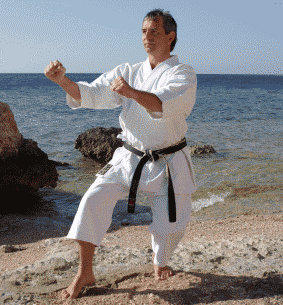
Ji'in
is
more
similar
to
Jion
than
Jitte
and
is
also
longer
than
Jitte.
However,
Ji'in
contains
pronounced
footwork
with
difficult
turns.
In
this
area
it
is
actually
the
most
difficult
of
the
three
Kata.
There
are
also
the
most
versions
of
Ji'in.
It
is
even
interpreted
and
performed
differently
in
the
Shotokan
schools.
The
biggest
differences
can
be
found
in
Ji'in
as
practiced
by
Hirokazu
Kanazawa.
In
Ji'in,
lateral
dodging
and
dodging
by
turning
over
the
back
are
practiced.
The
name
is
translated
as
floor
of
the
temple,
which
could
be
a
reference
to
the
importance
of
footwork.
Ji'in
is
the
only
one
of
the
three
Kata
that
ends
at
least
very
close
to
the
starting
point.
What
is
very
interesting
in
this
context
is
that
if
all
three
Kata
are
practiced
one
after
the
other,
you
reach
the
starting
point
again.
Hardly
any
of
the
"old"
Kata
end
where
they
began.
Many
old
masters
and
schools
practiced
outdoors,
where
there
were
no
spatial
restrictions.
However,
if
these
three
Kata
originate
from
the
Shaolin
Temple
and
were
practiced
by
groups
in
the
temple
courtyard,
one
might
assume
that
they
were
originally
a
single
Kata
that
was
only
broken
down
into
three parts on Okinawa.

Meaning of the name
Ten hands
Moves: 29

Jitte
Classification
Shorin-Ryu
Style
Shito Ryu / Shotokan
Level
Medium
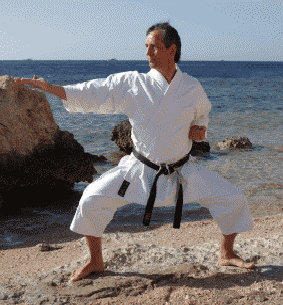
Jitte
is
the
shortest
of
the
three
Kata,
but
difficult
to
execute.
It
was
significantly
modified
in
Shotokan
and
interpreted
as
a
Kata
against
the
bo.
In
fact,
karate
is
fundamentally
also
intended
for
fighting
armed
opponents.
However,
no
Kata
was
developed
solely
for
practicing
fighting
with
a
weapon.
The
true
speed
of
the
techniques
in
combat
is
not
visible
in
the
Kata.
Jitte
offers
a
good
example
of
how
the
speed
at
which
a
technique
in
a
Kata
is
executed
should
be
chosen
so
that
an
optimal
learning
effect
is
achieved.
The
biggest
mistake
when
practicing
a
Kata
is
to
attach
more
importance
to
speed
than
to
perfection.
Furthermore,
each
technique
has
its
own
optimal
speed,
which
is
particularly
crucial
for
locking
and
throwing
techniques.
"What
is
fast
in
combat
is
slow
in
training."
(Wisdom
of
an
old
master
from
Wu
Dang).
This
could
be
seen
as
meaning
that
you
should
always
train
at
the
speed
at
which
you
learn
best.
The
different
speeds
of
techniques
in
a
Kata
should
therefore
also
be
viewed
from
this
perspective.
Because
every
technique
in
a
Kata
has
its meaning.
The
meaning
of
the
name
Jitte
(Ten
Hands)
is
unclear
and
subject
to
many
interpretations.
The
Kata
is
supposed
to
develop
a
strength
that
allows
one
to
fight
against
ten
men.
Others
attribute
the
name
to
the
Japanese
Jitte
(a
weapon
similar
to
the
sai).
Perhaps
the
name
also
indicates
that
Jitte
achieves
such
physical
strength
and
dynamism,
especially
in
the
core
muscles,
that
ten
hands
are
needed
to hold the master of this Kata.
Datenschutzerklärung:
Bei
karatekata.de
handelt
es
sich
um
ein
rein
informatives
Online
Angebot ohne kommerzielle Funktionen.
Alle
hier
veröffentlichten
Publikationen
enthalten
persönliche
Meinungen
des
Autors.
In
Fällen,
in
denen
externe
Informationen
eingebunden
werden,
werden
entsprechende
Quellenangaben
hinzugefügt.
Links
zu
anderen
Internetangeboten
oder
automatische
Weiterleitungen
sind
nicht
implementiert.
Navigation
Kata

DSGVO relevante Cookies sind nicht implementiert.








































































karatekata.de



