Meaning of the name
54 steps
Moves: 75

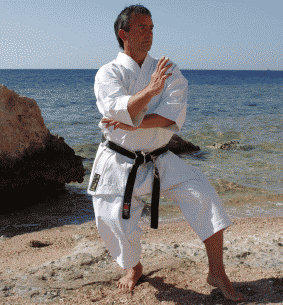
Gojushiho (Useishi)
Classification
Shorei-Ryu
Style
Shito Ryu
Level
Advanced
Gojushiho
is
considered
the
most
advanced
kata
of
the
Itosu
school
of
Shuri-te.
It
was
also
known
in
the
school
of
Sokon
Matsumura,
the
teacher
of
Yasutsune
Itosu,
and
is
interpreted
in
some
Shorin-Ryu
schools
as
the
kata
of
the
drunken
master.
According
to
Shito-Ryu
masters
of
the
Mabuni
school,
it
originally
comes
from
the
Aragaki
school,
from
which
the
Niseishi,
Sochin,
and
Unshu
also
originate.
Gojushiho (Aragaki Useishi) is a high-level kata.
However,
learning
how
to
apply
some
of
its
techniques
is
far
more
difficult
than
learning
the
kata
itself.
Some
techniques
require
very
precise
timing
and
are
only
optimally
successful
if
you
anticipate
the
opponent's
attack.
However,
the
techniques
do
not
require
special
hardening of the fingers and hands, such as the kata Unshu.
Gojushiho
contains
numerous
self-defense
techniques,
such
as
an
escape
technique
against
a
rear
grab.
It
also
practices
very
difficult-
to-use locking techniques against punches.
To
be
able
to
apply
some
of
these
techniques
in
real
life,
however,
one
must
be
able
to
anticipate
the
nature
of
the
opponent's
attack
at
its
inception.
The
fighting
principle
is
characterized
by
confusing,
sudden
actions
and
evasive
movements
through
body
twists
and
simultaneous
counterattacks.
Due
to
these
kata
elements,
Gojushiho
is
considered
the
most
advanced
kata
of
the
Itosu
school.
However,
the
purely
physical
demands
of
the
kata
are
not
as
high
as
those
of
Unshu.

Meaning of the name
24 steps
Moves: 44
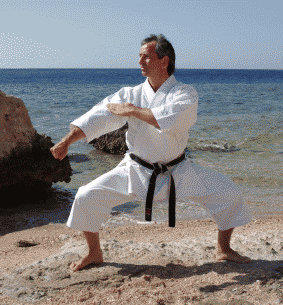
Niseishi
Classification
Shorei-Ryu
Style
Shito Ryu
Level
Medium
The
Niseishi
kata
is
fast
and
fluid,
but
its
inner
dynamics
are
difficult
to
learn.
The
transition
from
Neko
Ashi
Dachi
to
Zenkutsu
Dachi,
in
particular,
requires
special
use
of
the
ankles.
The
techniques
are
executed
in
a
way
that
tolerates
no
resistance.
Similar
to
water
forging
its
way
through,
the
entire
body
weight
is
incorporated
into
the
movement.
However,
it
is
very
difficult
to
bring
this
to
life
in
the
kata.
It
takes
a
long
time
to
learn
and
understand
the
barely
visible
subtleties
of
the
movements.
Niseishi
bears
a
certain
resemblance
to
Kururunfa.
However,
it
is
unknown
whether
Kururunfa
also
originated
in
the
Aragaki
school
or
was
trained
there.
There
is
no
direct
relationship
between
Niseishi
and
Unshu.
Only
the
technique
at
the
end
of
the
kata
with
Mawashi
Uke
and
Teisho
is
identical
to
the
end
of
the
Unshu
kata.
Niseishi
is
practiced
in
many
schools
and
is
performed
differently
there.
Ryuei
Ryu,
also
based
in
Naha,
also
uses
it.
However,
Niseishi,
practiced
in
Chito-Ryu
by
Master
Chitose,
is
a
completely different kata.

Meaning of the name
Calm power
Moves: 40

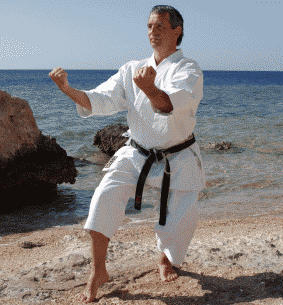
Sochin
Classification
Shorei-Ryu
Style
Shito Ryu
Level
Medium
Sochin
is
a
very
powerful
Kata,
but
also
one
that
incorporates
calmness
and
dignity.
Like
Unshu
in
Neko
Ashi
Dachi,
it
begins
with
Morote Yoko Uke, but here with a closed fist.
The
subsequent
punch
is
to
be
executed
with
extreme
power
and
explosiveness,
only
to
immediately
return
to
calm
and
composure.
This
technique,
at
the
beginning
of
the
Kata,
is
similar,
except
for
the
different
stance,
to
the
techniques
at
the
beginning
of
the
Kata
Sanchin, Seisan, Sanseiru, Shisochin, and Suparimpei.
Sochin
is
a
Kata
whose
alternation
of
calmness
and
power
is
striking
and must be emphasized during the execution of the Kata.
It
contains
techniques
that
promote
both
the
development
and
flexibility
of
the
core
muscles,
but
this
requires
the
will
to
do
it
correctly.
The
Shotei
Uke
technique
in
Zenkutsu
Dachi
while
stepping
back
was
adopted
by
Kenwa
Mabuni
in
the
development
of
the
Kata
Aoyagi.
The
style
of
execution
of
the
Kata,
with
its
alternation
between
calm
and
powerful
explosiveness,
is
reminiscent
of
the
Ryuei-Ryu
Kata
Paiku
and
Heiku.
Due
to
these
characteristics,
Sochin
could
be
classified
as
belonging
to
the
Tiger
style.
The
Shotokan
version
of
Sochin
is
a
completely
different
Kata,
developed
by
Yoshitaka
Funakoshi.
Bedeutung des Namens
Clouds storm
Bewegungen: 70
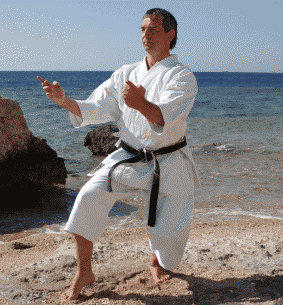
Unshu
Klassifizierung
Shorei-Ryu
Stilrichtungen
Shito Ryu
Unshu
(Unsu
in
Shotokan)
is
an
incredibly
versatile
Kata,
with
predominantly
demanding
techniques,
such
as
the
Ippon
techniques,
which,
however,
cannot
be
applied
without
special
training
of
the
hands
and
fingers.
The
technique
of
Ushiro
Geri
(Mawashi
Geri
in
Shotokan),
performed
while
kneeling,
is
a
typical
technique
of
the
Tiger
School.
Several
other
techniques
can
also
be
seen
in
a
similar
form
in
the
Kata
Kushanku,
Matsumura
Bassai,
and
Sochin.
The
quadruple
repetition
of
a
technique
(Gyaku
zuki
in
four
directions),
however, only exists in the heavily modified Shotokan version.
Unshu
is
an
immensely
fast
and
very
dynamic
Kata.
It
contains
diverse
footwork
with
many
turns
from
90
to
360
degrees,
as
well
as
forms
of
Tai
Sabaki,
Yori
Ashi,
and
Suri
Ashi.
The
important
interplay
between
footwork
and
arm
techniques
places
high
demands
on
coordination skills.
The
nature
of
the
Kata
is
like
a
storm,
with
the
wind
blowing
from
one direction to the other with varying force.
The
frequent
changes
of
direction
are
confusing
and
unexpected.
In
fact,
in
no
other
Kata
are
the
fighting
directions
changed
as
frequently and as quickly as in Unshu.
Although
it
originates
from
the
Aragaki
school,
it
bears
at
best
a
rudimentary
resemblance
to
the
Unshu
of
the
Aragaki
school.
Who
developed Unshu into its current form in Shito Ryu is unknown.
Einstufung
Advanced
Datenschutzerklärung:
Bei
karatekata.de
handelt
es
sich
um
ein
rein
informatives
Online
Angebot ohne kommerzielle Funktionen.
Alle
hier
veröffentlichten
Publikationen
enthalten
persönliche
Meinungen
des
Autors.
In
Fällen,
in
denen
externe
Informationen
eingebunden
werden,
werden
entsprechende
Quellenangaben
hinzugefügt.
Links
zu
anderen
Internetangeboten
oder
automatische
Weiterleitungen
sind
nicht
implementiert.
Navigation
Kata

DSGVO relevante Cookies sind nicht implementiert.














































karatekata.de



