Meaning of the name
Name of a city in China
Moves: 76

Anan
Classification
Shorei-Ryu
Style
Shito Ryu
Level
Advanced
The
Kata
Anan
bears
the
name
of
a
Chinese
city.
Kenri
Nakaima,
the
founder
of
Ryuei
Ryu,
lived
in
China
for
an
extended
period
and
studied
martial
arts
there.
In
addition
to
the
Kata
Anan,
Heiku,
Ohan,
Pachu,
Paiho,
and
Paiku,
he
also
learned
comprehensive
Kobudo,
which
remains
a
central
component
of
Ryuei
Ryu
today.
A
special
feature
of
the
aforementioned
Kata
is
that
all
techniques
are
repeated
no
more
than
twice.
This
can
sometimes
make
the
Kata
seem
shorter
than
they
actually
are.
This
is
especially
true
of
Anan,
which,
with
76
movements,
is
similar
in
length
to
Unshu
or
Gojushiho,
but
appears
considerably
shorter.
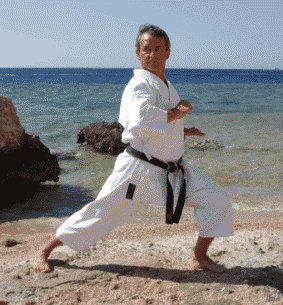
Anan
is
a
very
versatile
Kata.
It
is
extremely
demanding
and
utilizes
many
open
hand
techniques.
Even
more
so
than
Paiku
and
Heiku,
it
contains
quite
unusual
footwork
that
is
difficult to learn.
In
Kata
competitions,
however,
many
no
longer
use
these
special
features,
which
represents
a
significant
simplification
of
the
Kata.
However,
when
correctly
executed,
Anan
is
a
Kata
of
the
highest
technical
level.
Proper
use
of
the
hips,
especially
during
the
difficult
turns,
is
of
utmost
importance.
One-armed
techniques,
which
block
and
counter
in
one
movement,
are
also
practiced.
This
is
clearly
evident
in
the
combination
of
Otoshi
Empi,
Empi,
Yoko
Empi,
and
Shuto
Uchi.
However,
the
individual
techniques
are
combined
into
a
single, very fast movement.

Meaning of the name
Black Tiger
Moves: 65
Heiku
Classification
Shorei-Ryu
Style
Shito Ryu
Level
Advanced
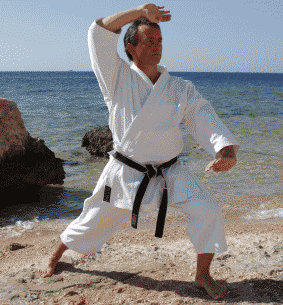
The
Kata
Heiku
represents
the
techniques
of
the
Black
Tiger
and
is
very
similar
to
the
Kata
Paiku.
However,
it
is
much
more
versatile
and
not
quite
as
powerful
and
dynamic.
However,
it
contains
many
hidden
and
sometimes
confusing
techniques.
It
also
includes
more
locking
and
throwing
techniques
than
Paiku.
Its
techniques
are
overall
more
complex,
but
also
more
fluid.
It
begins
like
Paiku,
but
Nihon
zuki
is
not
performed
exclusively
with
Chudan,
but
with
Jodan
and
Gedan.
The
Kata
requires
a
good
sense
of
balance
and
is
of
a
somewhat
higher
technical
difficulty
than
Paiku,
although
this
is
not
overtly
apparent.
The
techniques
at
the
end
with
Kote
Uke
and
Tate
Empi
in
combination
with
Yori
Ashi
in
particular
require
a
high
degree
of
coordination.
The
Kizami
Mae
Geri
techniques,
in
which
the
weight
must
not
be
shifted
to
the
back
leg,
are
particularly
difficult.
And
these
specialties,
which
utilize
physics
such
as
gravity
and
centrifugal
force
for
karate
techniques,
make
Heiku
a
very
demanding
and
high-
grade Kata of the same level as Anan, Unshu, Gojushiho or Chinto.

Meaning of the name
Swirl a ball
Moves: 48
Pachu
Classification
Shorei-Ryu
Style
Shito Ryu
Level
Advanced
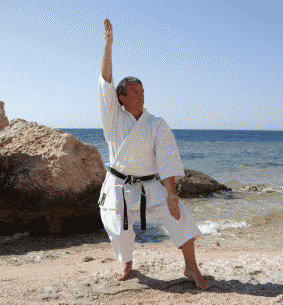
Pachu
is
an
extremely
fast
and
dynamic
Kata
with
very
difficult
combinations.
It
teaches,
in
particular,
lateral
evasive
maneuvers,
which also involve "moving into" the opponent.
Particular
attention
is
also
paid
to
the
"simultaneity"
of
defense
and
counterattack.
This
is
clearly
evident
in
this
Kata
with
the
examples
of
Osae
Uke
and
Nukite,
as
well
as
the
combination
of
Jodan
Uke
and
Mae
Geri.
In
some
respects,
it
shows
similarities
to
Heiku
and
Paiku,
but
is
considerably
shorter.
Pachu
most
likely
originates
from
the
Tiger
School.
Its
name
means
"to
spin
a
ball."
And
indeed,
it
contains
many
techniques
that
are
performed
from
a
turn
or
are
combined
with
a
turn.
But
it
also
contains
very
direct
and
dangerous
techniques.
Pachu
is
the
shortest
of
the
four
Kata;
it
contains
only
a
few slow techniques or powerful individual techniques.
Her
character
is
characterized
by
speed
combined
with
surprising
combinations,
which
also
involve
very
rapid
changes
in
attack
plane.
Thus,
techniques
with
low
and
high
stances
are
executed
in
rapid
succession.

Meaning of the name
Moves: 62
Paiho
Classification
Shorei-Ryu
Style
Shito Ryu
Level
Advanced
Paiho
is
a
typical
White
Crane
Kata,
and
its
first
part
is
very
similar
to
Hakkaku,
Hakucho,
Haufa,
and
some
versions
of
Hakutsuru.
After
beginning
the
Kata
with
Soe
Uke,
Morote
Kuri
Uke,
and
Nukite
are
repeated three times.
A
combination
with
Ko
Uke
is
performed
twice
sideways,
and
Ko
Uchi
is
performed
three
times
forwards.
Halfway
through
the
Kata,
the
turn
and
the
complete
repetition
of
the
first
half
follow.
This
concept
is
not
found
in
any
other
known
Kata
and
indicates
that
the
Kata
has
a
more
fundamental
character.
Therefore,
like
Haufa,
it
is
well
suited
for beginning students of the White Crane school.
It
is
a
very
rare
Kata
in
Ruyei
Ryu,
as
Ruyei
Ryu
otherwise
almost
exclusively
favors
Kata
from
the
Tiger
School.
However,
Paiho
also
contains
a
technique
found
in
Seisan,
and
Seisan,
in
turn,
can
be
assigned
to
the
Tiger
School.
Since
the
Crane
and
Tiger
techniques
significantly
shape
Okinawan
karate,
it
is
possible
that
influences
from
the
other
animal
styles
can
also
be
found
in
specific
Kata.
At
least
two
versions
of
Paiho
exist,
which
are
very
different
from
each
other.
The
version
not
described
here
is
identical
to
Hakkaku
in
its
first part.
Meaning of the name
White Tiger
Moves: 66
Paiku
Classification
Shorei-Ryu
Style
Shito Ryu
Level
Advanced
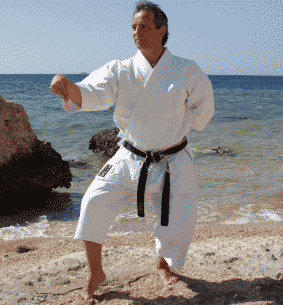
The
Kata
Paiku
represents
the
techniques
of
the
white
tiger.
It
is
a
very
strong,
power-focused
Kata
and
places
great
demands
on
the
thigh
muscles.
Its
techniques
are
executed
with
great
strength
and
fighting
spirit.
The
character
of
the
Kata
displays
a
cold,
furious
determination.
Slow
techniques
are
suddenly
followed
by
incredibly
dynamic
techniques
executed
with
all
possible
power
and
speed.
The
combination
of
Kote
Uke,
Tate
Empi,
Morote
Osae
Uke,
and
Morote
Ippon
Ken
zuki
is
particularly
demanding.
This
combination
is
executed
so
quickly
that
individual
movements,
such
as
zukami
(grabbing)
after
Kote
Uke
or
Morote
Osae
Uke,
are
no
longer
visible.
Ippon
Ken
techniques
are
also
a
specialty
of
this
Kata.
Another
specialty
is
the
Age
Uke
performed
while
kneeling,
followed
by
simultaneous
Age
Uke
and
Mae
Geri,
which
again
demands
the
thigh
muscles.
Furthermore,
Paiku
is
the
only
Kata
of
the
old
school
in
which a high Yoko Geri is performed.
Datenschutzerklärung:
Bei
karatekata.de
handelt
es
sich
um
ein
rein
informatives
Online
Angebot ohne kommerzielle Funktionen.
Alle
hier
veröffentlichten
Publikationen
enthalten
persönliche
Meinungen
des
Autors.
In
Fällen,
in
denen
externe
Informationen
eingebunden
werden,
werden
entsprechende
Quellenangaben
hinzugefügt.
Links
zu
anderen
Internetangeboten
oder
automatische
Weiterleitungen
sind
nicht
implementiert.
Navigation
Kata
DSGVO relevante Cookies sind nicht implementiert.














































karatekata.de



